

At the annual meeting on June 6, some investors questioned leaders of VNG Corporation (ticker: VNZ) about why the stock has been sluggish even though the company is among the leading technology firms.
VNG has about 30 million shares trading on UPCoM, but the average 10-session liquidity is under 1,000 shares. The closing price this weekend was VND 317,000, about 13% lower than at the start of the year and sharply down from the record near VND 1.5 million when it first listed.
Responding to shareholders, VNG Chairman Le Hong Minh said the current share price does not fully reflect the company’s value for several reasons. First, share liquidity is frequently low because the company chose not to issue more shares when it listed in 2023. As a result, the shareholder structure remains mainly institutions and long-serving employees through the preferential share issuance program (ESOP).
“When the price falls, these people do not want to sell, which leads to low liquidity. When liquidity is low, it is even harder to attract new investors,” Mr. Minh said.
The second reason, according to Mr. Minh, is that VNG’s leadership is very reluctant to make grand statements or big promises to stimulate the stock. He maintains the view of working diligently and creating good products for consumers, thereby improving financial metrics, instead of focusing on polishing the stock.
However, the chairman also acknowledged that the company had not done well in providing business information to investors in the past. He committed to improving this going forward and to meeting the legal criteria to list shares on a main exchange (HoSE or HNX).

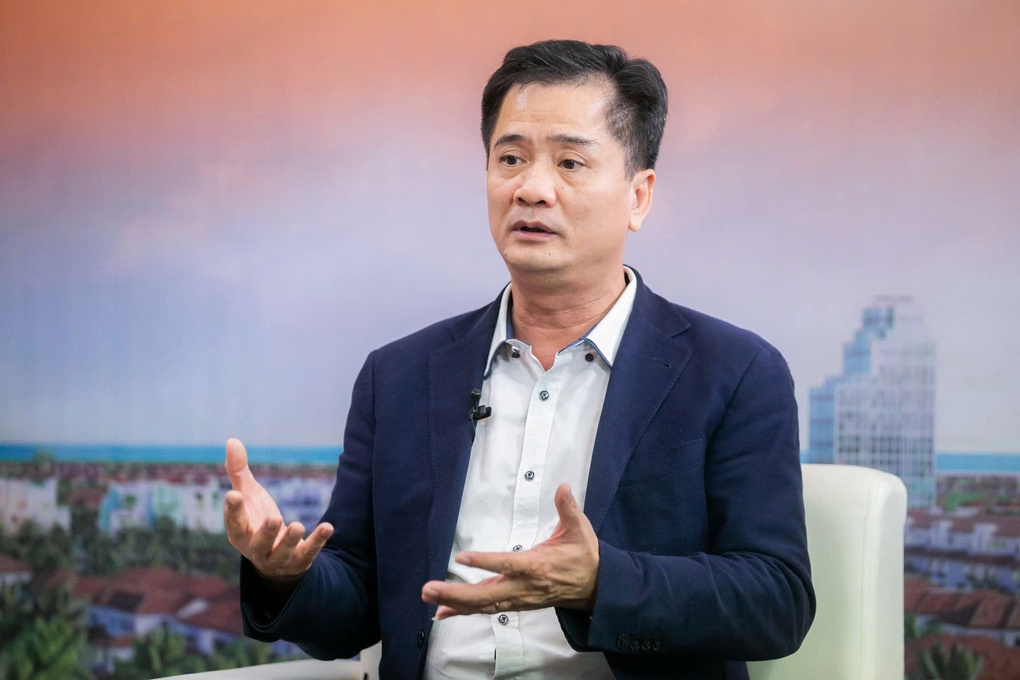
Chairman Le Hong Minh at the annual meeting on June 6. Photo: VNG provided
Chairman Le Hong Minh at the annual meeting on June 6. Photo: VNG provided
This year VNG expects revenue between VND 12,500 billion and VND 13,500 billion, and pre-tax profit of VND 300–450 billion. This is the first time they have set a profit target since listing, ending a loss streak that began in 2021. This year’s target is on track as the company recorded VND 2,785 billion in revenue and VND 125 billion in post-tax profit in the first quarter.
VNG plans not to pay dividends. According to management, the undistributed profit of VND 558 billion will be retained for investment activities and product development.
On future strategy, Mr. Minh said artificial intelligence (AI) is having a major impact on VNG’s business decisions, surpassing the two previous technology waves: the internet boom in the early 2000s and smartphones in the early 2010s. VNG aspires to develop pure AI products, but this is not an immediate priority.
“The most important thing now is to integrate AI into existing products and optimize operations,” Mr. Minh shared.
He gave examples: in the online games segment, AI shortens content creation time from several weeks to a few hours and automates the game release process. The Zalopay payment app uses AI for automated customer care, reducing response time from 10 minutes to a few seconds, while increasing the effectiveness of detecting abnormal transactions by 60%.
According to Mr. Minh, in the AI era VNG does not develop products or apps serving only a single customer group. Instead, they are building a digital ecosystem that includes connectivity platforms, payments, entertainment, and AI infrastructure. Company leaders assess this as an ecosystem that not many companies in Southeast Asia currently possess.
Phuong Dong






Leave a Reply