
This opinion was stated by Mr. Le Huu Nghia, General Director of Le Thanh Company, at the HUBA Entrepreneur Coffee program themed “Social housing – rental housing, settlement solutions for workers” on June 20.
According to Mr. Nghia, the demand for social housing and rental housing in Ho Chi Minh City is currently very large, with nearly one million people in need. However, the problem with this segment is that the capital recovery period is long, while investment costs and project construction procedures take many years before generating cash flow.
He cited a rental housing project of 1,000 apartments with a total capital of about 1,000 billion VND. If the enterprise borrows 800 billion VND at an interest rate of about 10% a year and takes 6-7 years from procedures to construction, the interest cost alone during this period can reach hundreds of billions of VND. Once operational, the rental cash flow is also unlikely to cover the capital cost.
“No enterprise can survive this problem,” Mr. Nghia said, adding that the prerequisite for this model to be feasible is long-term capital of 15-20 years, an interest rate of 4-5% a year, along with preferential mechanisms regarding taxes, land, and investment procedures.

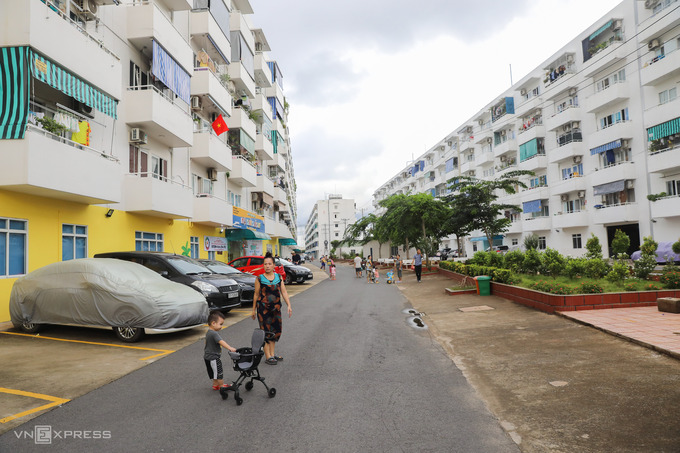
Life in a social housing area in Ho Chi Minh City. Photo: Quynh Tran
Life in a social housing area in Ho Chi Minh City. Photo: Quynh Tran
Similarly, Mr. Le Nhu Thach, Chairman of the Board of Directors of Bcons Group – a project development enterprise, believed that to develop this type of housing, State participation is needed through policies on land, credit, and investment mechanisms.
“Enterprises can share profits, but without a suitable policy foundation, it is very difficult to form a large-scale rental housing market,” he said.
Mr. Nguyen Ngoc Hoa, Chairman of the Ho Chi Minh City Union of Business Associations (HUBA), assessed that the trend of rental housing is gradually replacing the traditional home-selling model as workers no longer have to bear the pressure of initial capital accumulation and prolonged debt repayment. However, this shift also changes the financial structure of the market. At this point, the capital pressure is no longer on buyers but shifts to project development enterprises – the group that has to wait for cash flow recovery over a long period.
According to him, without a sufficiently long credit mechanism and low capital costs, along with a significant shortening of investment procedures, rental housing will struggle to become a true market segment, despite the huge actual demand.
Regarding preferential policies and investor support, Mr. Huynh Quang Thanh, Deputy General Director of Ho Chi Minh City State Financial Investment Company (HFIC), said the city is implementing an interest rate support mechanism for social housing, workers’ housing, and student dormitory projects.
Accordingly, enterprises can access loans with commercial interest rates of about 7.9-8.9% a year. After being supported by the city budget, the actual cost that enterprises have to pay is only about 0-1% a year, meaning they almost get interest-free loans in some cases.
However, Mr. Thanh stated that the number of projects accessing this mechanism is still limited due to investment procedure hurdles, reciprocal capital requirements, and conditions on domestic capital ownership structure. HFIC is proposing to raise the preferential loan limit from 200 billion VND to 300 billion VND per project, and simultaneously extend the interest rate support period to 10 years, instead of 7 years as before, to better match the actual investment cycle.
To achieve the goal of developing 100,000 rental housing units by 2030, experts believe that Ho Chi Minh City needs to simultaneously expand preferential credit with actual interest rates much lower than the market, extend the support period to match the project life cycle, and strongly reform investment procedures.
Some opinions also proposed forming a social housing development fund from the 20% land fund revenue, combining flexible land financial obligation mechanisms for rental housing to create more long-term capital sources. This is considered an important condition to transition from fragmented support programs to a sufficiently strong policy ecosystem for the sustainable development of the rental housing segment.
Phuong Uyen





Leave a Reply