
Secondary transfer prices of apartments in HCMC recorded a 5-10% decrease in the second quarter, but liquidity remained slow as buyers continued to expect prices to drop further.
Ms. Duyen, the owner of a 71-square-meter, two-bedroom apartment in a project in Thanh My Tay Ward, said she has been listing it for sale since the beginning of the second quarter but has not found a buyer yet. At the end of last year, the apartment was valued by brokers at around 10.8 billion VND. After months without any transactions, she lowered the asking price to 10 billion VND and is willing to negotiate further with buyers who have real needs.
“Quite a few customers came to view, but most are still waiting for prices to drop further or comparing it with other units that are being heavily discounted by their owners,” she said.
Similarly, Mr. Hai, the owner of an apartment of over 70 square meters on Nguyen Van Troi Street (Phu Nhuan District), is listing it for about 7.2 billion VND, nearly 300 million VND lower than at the end of 2024. According to him, last year, units of the same size were traded at over 8 billion VND, and currently, many owners have reduced prices by 200-300 million VND to find buyers. Nonetheless, liquidity remains very slow.
“Many buyers believe that financial pressure will force some owners to continue lowering prices, so they are in no hurry to make a payment,” Mr. Hai said.
In suburban areas, liquidity pressure is even greater as new supply is continuously added. An investor said he is listing a two-bedroom apartment for a loss at 3.8 billion VND, which was bought mostly with bank loans. Each month, this investor has to spend more than 20 million VND on principal and interest, while the rental income is only about 8 million VND.
After nearly a year of struggling with cash flow, he accepted lowering the price to 3.5 billion VND but has not found a buyer. Currently, many apartments in this project have also seen price reductions of 200-300 million VND for quick resale contracts.

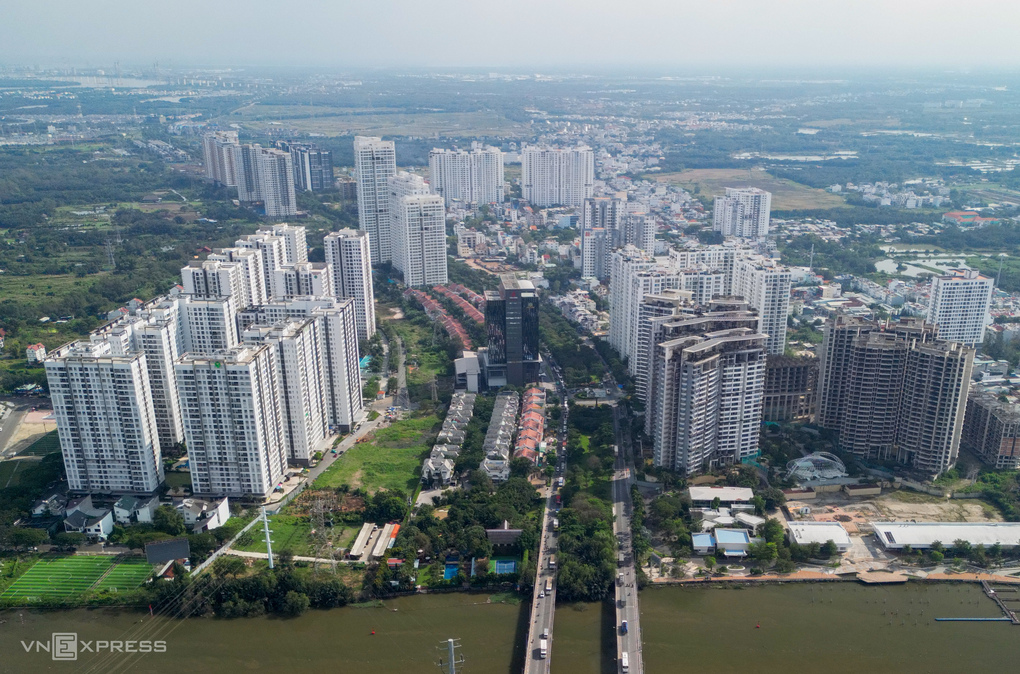
Real estate in South HCMC, December 2024. Photo: Quynh Tran
Real estate in South HCMC, December 2024. Photo: Quynh Tran
VnExpress’s records also show that the downward price trend is appearing in many secondary apartment projects in HCMC. The common adjustment level is 5-10% compared to the beginning of the year, focusing on apartments that need to be sold quickly or belong to investors using financial leverage. In some cases where urgent capital recovery is needed, owners accept reductions of over 10%, yet it still takes a long time to find buyers.
In the high-end segment in central and near-central areas, asking prices for secondary apartments also decreased by about 8-10% compared to the beginning of the year. According to brokers, most of the reductions come from owners under pressure to repay loans or needing to recover capital, while apartments with good locations and complete legal status still maintain more stable prices. Although selling prices have cooled down, buyers still maintain a waiting attitude, expecting the price level to drop further, which prolongs the negotiation process and keeps transaction volume from improving significantly.
A report from DKRA Consulting shows that secondary apartment prices in HCMC in the second quarter decreased by an average of 3-6% compared to the previous quarter. Specifically, the East and North regions decreased by about 2-6%, the West and South regions decreased by 4-6%, and the central area decreased by 3-5%. Similarly, historical price data from the specialized site Batdongsan also recorded that secondary listing prices in many projects in HCMC adjusted downward by 3-7% compared to the beginning of the year.
The above trend is occurring as the market enters a repricing phase after a hot growth cycle. High price levels over many years have increasingly limited buyers’ affordability, while new supply is continuously added, creating competitive pressure on the secondary market.
Knight Frank Vietnam’s second-quarter report stated that the HCMC area (former boundary) only recorded 1,781 apartments consumed, a 24% decrease compared to the same period last year. New supply launches remained concentrated in the high-end and luxury segments, making buyers more cautious. Across the expanded HCMC area, the entire market recorded an absorption rate of about 39%, much lower than the same period last year. Purchasing power remained modest due to high selling prices and home loan costs not yet cooling down.
According to the Vietnam Association of Realtors’ Market Research and Assessment Institute (VARS IRE), the price reduction phenomenon in the secondary apartment market appeared at the beginning of this year but mainly concentrated on the group of investors who bought when the market was hot and used high bank loan ratios.
The institute believes that many loans are entering the phase where both principal and interest must be paid, while the rate of price growth has slowed down and capital costs have increased, forcing many investors to lower their profit expectations or even accept selling below the purchase price to restructure their cash flow. In addition, a segment of investors who bought based on FOMO (fear of missing out) expecting short-term flipping also had to sell when the market was no longer rising as before.
Besides financial pressure, the secondary market also faces competitive pressure from new supply and promotional policies from developers. Buyers have more choices, thus extending their decision-making time, forcing apartments with high prices or weak competitive advantages to continue adjusting to attract customers.
Mr. Vo Hong Thang, Deputy General Director of DKRA Group, said that the current secondary apartment price adjustment mainly reflects the liquidity pressure of a segment of investors, rather than a decline of the entire market. According to him, the group that has to reduce prices is mainly investors using large financial leverage or needing to recover capital, while owners with strong financial capacity are still not under pressure to sell at all costs.
Mr. Thang assessed that this is a rebalancing process after a period of rapid apartment price increases over the past few years. The adjustment pressure will be clearer in the high-end segment due to large asset values, a limited customer base, and buyers becoming increasingly cautious when spending money.
Experts forecast that price adjustment pressure in the secondary apartment market may continue in the final months of the year if interest rates remain high. Buyers will hold the negotiating advantage thanks to abundant supply and many promotional policies from developers.
However, the downward trend is unlikely to spread widely across the entire market because apartment supply in inner-city HCMC remains limited, while real housing demand is still large. The market is predicted to polarize more strongly, with projects in good locations, with complete legal documents, and reasonable prices continuing to maintain liquidity, while products priced higher than their actual value will have to adjust to find buyers.
Phuong Uyen




Leave a Reply