
US home prices hit record high
A supply shortage pushed US home prices to a record high in June, with the median price exceeding 440,000 USD per home.
On July 9, the National Association of Realtors (NAR) released a report showing that in June, nationwide home sales fell 2.4% compared to the previous month.
The median price of existing homes also rose 1.8% compared to the same period last year, to a record 440,600 USD. Most homes sold in June were in the 250,000 to 500,000 USD price range. However, sales figures are calculated after transactions are completed, so last month’s sales likely reflect contracts signed in April and May.
The US is facing a nationwide housing shortage. The National Association of Home Builders (NAHB) estimates the shortage is around 1.2 million units. The inventory of previously owned homes for sale on the market decreased by 0.6% last month to 1.56 million units. This figure is still lower than the pre-pandemic level of 1.8 to 1.9 million units. However, compared to the same period last year, supply has increased by 1.3%.

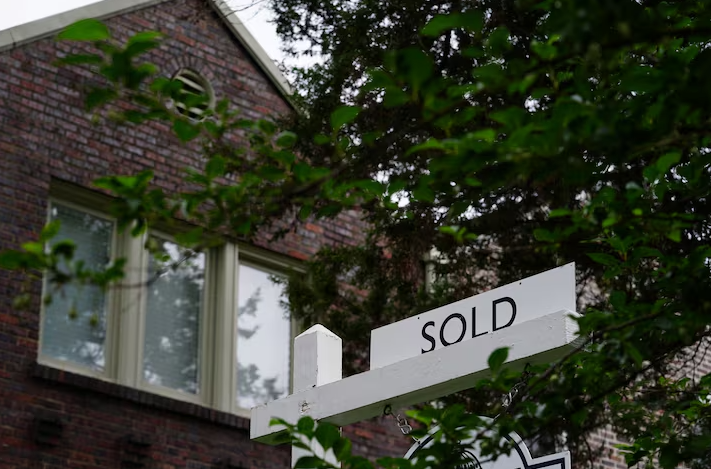
A “Sold” sign placed outside a house in Washington in July 2022. Photo: Reuters
A “Sold” sign placed outside a house in Washington in July 2022. Photo: Reuters
The NAR report shows that affordability barriers are growing for many young Americans. The country’s Congress recently passed a bill aimed at lowering housing prices. However, President Donald Trump has not yet signed it, waiting for another bill regarding elections to be passed.
“The affordability challenge is currently greatest for low-income households and first-time homebuyers. Purchasing real estate is much more accessible for high-income households—the group most likely to already own a home,” noted Nancy Vanden Houten, lead economist at Oxford Economics.
Compared to the same period last year, home sales in June rose 2.8%. Sales of homes priced above 500,000 USD recorded double-digit growth compared to the same period. Meanwhile, sales of homes under 100,000 USD fell 1.7%.
Mortgage rates have cooled down after a period of surging due to the Middle East conflict. However, the average rate for a 30-year fixed mortgage—the most popular type—remains about 50 basis points (0.5%) higher than before the conflict, according to data from mortgage lender Freddie Mac.
High interest rates make many homeowners reluctant to list their properties, further exacerbating the supply shortage. Many homeowners currently have mortgages with fixed rates below 5%. In addition, the Middle East conflict has increased inflationary pressures, giving the US Federal Reserve (Fed) more reason to consider raising interest rates this year. Minutes from the Federal Reserve’s June 16-17 meeting, released this week, showed that policymakers are increasingly concerned about inflation.
The Fed kept its benchmark interest rate unchanged at 3.5-3.75% at its June meeting. However, new projections show that many views lean toward an interest rate adjustment this year.
Ha Thu (according to Reuters)








Leave a Reply