
Developers use technical price cuts to stimulate demand
Many developers are maintaining listed prices but ramping up discounts, interest rate subsidies, and extended payment schedules, making technical price cuts a common strategy.
The residential market report for the first half of 2026 by the Dat Xanh Services Real Estate-Finance-Economics Research Institute (DXS-FERI) shows that technical price cuts are becoming a key sales strategy for many real estate businesses amid a clear decline in purchasing power.
According to DXS-FERI, in the first half of the year, there were about 37,300 new products launched nationwide, a 16% increase compared to the same period last year, but sales only reached about 26,000 products, down 12% year-on-year and down 62% compared to the second half of last year, dragging the common absorption rate down to 20-30% (an average decrease of 10-15 percentage points).
In the context of weakening liquidity while primary prices remain anchored at high levels, to stimulate demand, many developers have shifted to maintaining listed prices while expanding discount policies, interest rate support, principal grace periods, and extended payment schedules. According to DXS-FERI, this is a form of technical price cuts, meaning reducing the actual cost the buyer has to pay without adjusting the announced selling price.

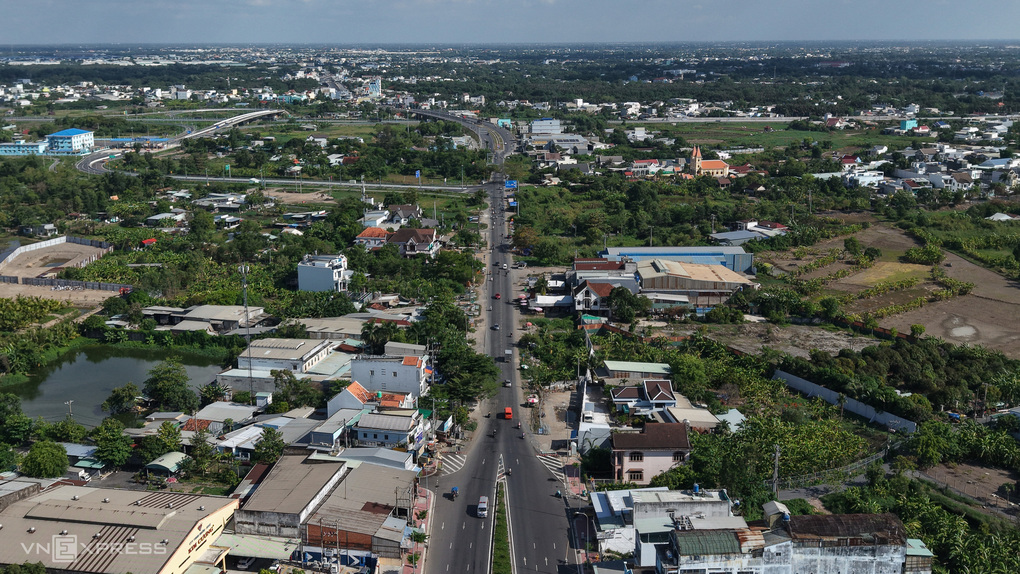
Real estate in the Eastern area of Ho Chi Minh City, December 2025. Photo: Quynh Tran
Real estate in the Eastern area of Ho Chi Minh City, December 2025. Photo: Quynh Tran
Unlike lowering the listed price, with a technical price cut, an apartment is still announced at its original price, but customers can receive discounts for early payment, interest rate support in the initial years, principal grace periods, or extended payment schedules over several years. As a result, the actual amount the buyer has to pay is significantly reduced, while the project’s announced price level remains unchanged.
DXS-FERI noted that this trend is being increasingly adopted by businesses as home loan interest rates after the promotional period remain commonly at 12-14% per year, making buyers hesitant about products requiring large financial commitments.
This development was also recorded by DKRA Consulting in the Ho Chi Minh City and surrounding areas market. According to this unit, although new supply in the second quarter reached more than 12,000 products, up 13% year-on-year, purchasing power in the primary market decreased by 11%.
Poor liquidity and high loan interest rates have forced many developers to step up sales policies such as discounts, interest rate support, principal grace periods, and extended payment schedules to stimulate demand. Thanks to this, the primary price level generally remains stable, but the actual cost to the buyer has decreased significantly.
Mr. Vo Hong Thang, Deputy CEO of DKRA Group, said that the simultaneous implementation of financial incentive programs by many businesses instead of lowering listed prices reflects a shift in the market’s sales strategy. In the context of declining purchasing power but high project development costs, developers are forced to find a balance between maintaining liquidity and protecting asset values.
According to him, it is not easy for businesses to publicly reduce selling prices because this could drag down the price level of the entire project, affecting the interests of previous buyers, and impact the valuation of collateral assets as well as future fundraising capabilities. Therefore, policies such as discounts, interest rate support, principal grace periods, or extended payment schedules are considered more flexible solutions, helping to reduce financial pressure on buyers while maintaining the listed prices.
Mr. Thang believed that this trend also shows that the priorities of many developers have changed. If previously the goal was to maximize profit by increasing selling prices, the top priority now is to maintain cash flow, accelerate sales velocity, and ensure project implementation plans. This means businesses are willing to share a portion of their profits with customers, as long as the project’s price level is preserved.
Looking ahead, DXS-FERI forecasts that the residential market in the second half of the year will continue to recover in a divergent and selective manner. New supply is expected to increase by about 33,000 products, bringing the total primary supply nationwide to over 100,000 products.
However, demand is projected to remain cautious, with an absorption rate of around 20-30%. This trend will likely cause primary price levels to move sideways or continue to be adjusted through sales policies. In addition, a strong market recovery scenario is considered unlikely if home loan interest rates remain around 12-14% per year.
Phuong Uyen





Leave a Reply