
This observation was recently made in the AI Impact: Regional Insights Asia Pacific report by Cushman & Wakefield, which studies the impact of AI on economic growth and the real estate market in the Asia-Pacific (APAC) region over the next decade.
Contrary to the popular belief that AI will reduce the demand for office or retail space as many jobs become automated, Cushman & Wakefield believes the impact of this technology should be viewed on an economy-wide scale.
Dominic Brown, Head of International Research for Asia Pacific at Cushman & Wakefield, stated that while AI may replace some repetitive tasks, it simultaneously helps businesses improve productivity, reduce operating costs, and expand their operations. As productivity increases, economic output, the number of businesses, and recruitment demand also tend to rise, leading to greater demand for offices, warehouses, data centers, and retail spaces.
In the most probable baseline scenario, the APAC economy is forecast to grow by about 3-4 percent annually until 2030, thanks to productivity improvements from AI. Although some job positions may be displaced, total employment in the region is still projected to increase by approximately 58.5 million during the 2026-2030 period.
According to Brown, this prospect of economic expansion is the basis for affirming that AI will play a complementary role rather than a substitutive one regarding commercial real estate demand.

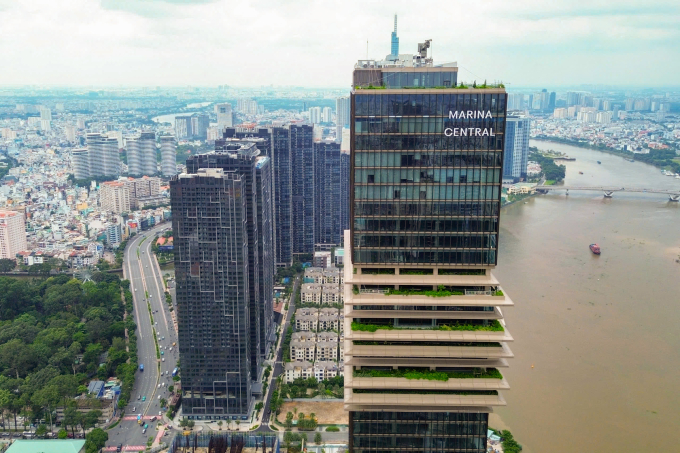
Outside the Saigon Marina IFC commercial building in Ho Chi Minh City. Photo: Quynh Tran
Outside the Saigon Marina IFC commercial building in Ho Chi Minh City. Photo: Quynh Tran
Among the segments, offices are considered one of the most clear-cut beneficiaries, although demand will shift towards being more selective. Cushman & Wakefield forecasts that the total net absorption of Grade A offices in APAC could exceed 96 million square meters over the next 10 years.
Businesses adopting AI generally have a higher demand for quality workspaces that support collaboration, research, and innovation. This causes the flight to quality trend to continue growing, widening the gap between premium office buildings and lower-quality projects.
This view is also shared by JLL. According to this agency, AI is driving the formation of new tech hubs in cities with high-quality human resources and developed innovation ecosystems. AI companies tend to concentrate their teams of engineers, data experts, and research and development staff in a single location to enhance work efficiency, thereby sustaining the demand for Grade A office buildings.
Reality in the US shows that this trend has already begun to emerge, as many AI companies expand their leased office space in tech hubs to serve product research and development, contributing to a rebound in leasing demand in certain markets after a period of pressure from the remote work trend.
In the industrial segment, the application of automation in manufacturing, the expansion of e-commerce, and the need for supply chain optimization are increasing the demand for modern warehouses, distribution centers, and logistics infrastructure. Cushman & Wakefield predicts that the total net absorption of the logistics and industrial segment in APAC could reach over 236 million square meters by 2030.
While the main growth driver in the previous period came from the trend of shifting global supply chains, AI and the digital economy are forecast to become a new market driver in the coming years.
Most notable is the rise of data centers. The development of generative AI models requires increasingly large data processing, storage, and transmission capabilities, leading to heavy investment demand in digital infrastructure.
Matt Madden, Senior Director of Data Centre Solutions for Asia Pacific at CBRE, assessed that AI is creating unprecedented demand for data centers in the region. According to him, suitable power supply and land funds are increasingly becoming crucial competitive factors for investors as the demand to develop AI-serving infrastructure grows rapidly.
Regarding retail, AI is expected to boost income growth and purchasing power by improving labor productivity and corporate operational efficiency. However, experts believe these benefits will not be distributed evenly. High-end shopping malls or projects capable of creating distinct shopping and entertainment experiences are forecast to have more advantages, while the mid-range segment will continue to face competitive pressure due to increasingly polarized consumer behavior.
In Vietnam, the market possesses many favorable conditions to catch the wave of AI-related investments. The continued expansion of manufacturing, positive FDI inflows, accelerated digital transformation, and the need to develop the digital economy are creating a foundation for the development of industrial real estate and data infrastructure.
Hoang Nguyet Minh, General Director of Cushman & Wakefield Vietnam, stated that applying AI in research, development, and project operations will become increasingly necessary for domestic real estate enterprises.
According to her, Vietnam’s industrial real estate is supported by manufacturing growth, export-oriented investments, and rising domestic consumer demand. In addition, the data center market also holds long-term potential due to competitive construction costs, rapid digitalization, and the growing demand for cloud computing.
As for offices and retail, AI could widen the quality gap between projects while boosting demand for assets with good locations, high operational quality, and the ability to meet the new requirements of tenants.
Although the overall outlook is considered positive, Cushman & Wakefield notes that the impact of AI still depends on the speed of practical application and the adaptability of the labor market. Nevertheless, in the baseline scenario, AI is seen as one of the most important growth drivers for commercial real estate in the coming decade, especially in emerging markets like Vietnam.
Phuong Uyen






Leave a Reply