
The housing demand among workers in Ho Chi Minh City is huge, but not everyone aims for homeownership. According to Mr. Le Hoang Chau, Chairman of the Ho Chi Minh City Real Estate Association (HoREA), a significant portion of migrant workers currently only need stable accommodation at an affordable cost to work and live in the city.
Citing a survey by the Department of Construction and the Ho Chi Minh City Institute for Development Studies across 17 industrial parks, export processing zones, and high-tech parks, Mr. Chau stated that about 60 percent of the 280,000 surveyed workers have a demand for renting homes. Many individuals plan to work in the city for only about 10 to 12 years before returning to their hometowns, so they have no intention of buying a house.
This reality is evident in many enterprises employing a large number of migrant workers. At PouYuen Company, which has about 55,000 employees, mostly migrants, roughly 80 percent of the workers are renting houses outside. Due to the lack of housing supply near their workplaces, many people have to rent rooms in neighboring areas and commute long distances every day.
“There are cases where workers, to save costs, rent houses in Ben Luc and then take shuttle buses to the factory,” Mr. Chau noted, affirming that the demand for rental housing near industrial parks remains very high but has not been adequately met.
According to the Ho Chi Minh City Confederation of Labor, the majority of workers currently find it difficult to access housing because their income cannot keep up with the rising house prices. With an average salary of about 10 million VND per month, after covering living expenses, workers can only save about 4 to 6 million VND.
Meanwhile, the price of a social housing unit currently ranges from 1.2 to 2 billion VND. With this level of savings, it would take many people decades to afford a house, not to mention the pressure of installment payments if they take out a loan. Therefore, for many migrant workers, the urgent need right now is stable accommodation with suitable rental costs rather than homeownership.

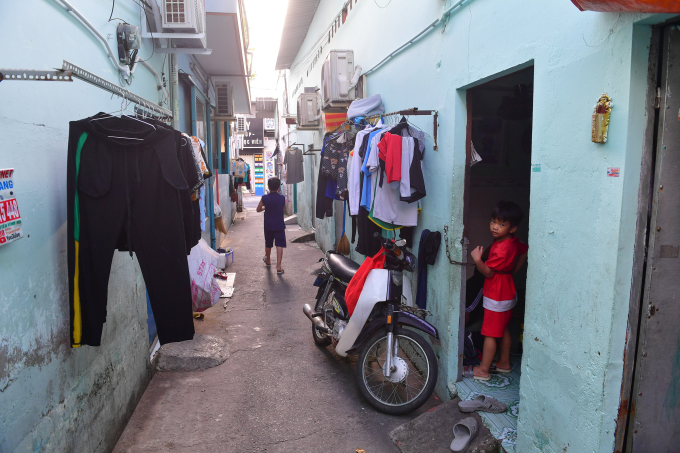
A worker rental housing area in Ho Chi Minh City. Photo: Thanh Tung
A worker rental housing area in Ho Chi Minh City. Photo: Thanh Tung
According to statistics from Ho Chi Minh City’s departments and agencies, the demand for renting and lease-purchasing social housing among the workforce is currently over 30,000 units, expected to increase to nearly 300,000 units by 2030. Meanwhile, the city only has about 13,668 apartments and rental rooms in the social housing and public rental housing funds, most of which are already fully occupied.
In addition to the social housing fund, the city also has several worker accommodation models invested by enterprises, such as the Linh Xuan accommodation area, Tanimex housing areas, or the accommodation at Linh Trung Export Processing Zone. The private sector has also seen effective rental projects, such as 800 apartments by Le Thanh Company in An Lac or rental buildings priced under 2 million VND per month invested by businessman Le Huu Nghia. However, the scale of these models is still modest, only meeting about 15 percent of the necessary accommodation for workers.
In the context of limited formal supply, the private rental housing system remains the choice of the majority of migrant workers. According to the Department of Construction, Ho Chi Minh City currently has more than 60,000 rental housing areas with nearly 630,000 rooms for rent, providing accommodation for about 1.8 million people.
Mr. Phan Tran Huy Hung, Vice Chairman of the Ho Chi Minh City Association of Construction Science and Technology, stated that most workers in industrial parks, export processing zones, high-tech parks, logistics centers, and services currently depend on rental housing. For many, accessing affordable accommodation is a crucial condition to maintain employment and stabilize their lives in the city.
He mentioned that although the city plans to develop about 50,000 rental houses in the coming time, this scale still has a significant gap compared to the number of workers in need of affordable accommodation.
According to Mr. Le Hoang Chau, one of the reasons the rental housing segment is developing slowly is its lower financial efficiency compared to the home-selling model. Investors have to inject large amounts of capital, but the payback period can extend to 15 to 20 years, while they have not fully enjoyed preferential policies on land, taxes, and credit.
Mr. Chau argued that there is currently a paradox where the law has recognized rental rooms as a form of social housing for rent, but landlords receive almost no corresponding support policies.
To encourage the development of rental housing, departments and associations propose adding preferential mechanisms regarding land, taxes, and credit for projects with prices suitable for workers’ incomes. According to these units, rental housing should be considered an important component of housing welfare policies, instead of focusing solely on homeownership goals.
Besides developing new projects, the city is recommended to prioritize allocating rental housing near industrial parks, high-tech parks, employment centers, and metro lines so that workers can easily live and commute. The existing rental housing system also needs to be renovated and upgraded to better meet the requirements for living quality and safety.
Experts suggest that rental costs should only account for about 20 to 25 percent of monthly income. Therefore, along with increasing the supply, there needs to be a mechanism to control rental prices and protect tenants’ rights to move towards a more stable and sustainable rental housing market.
Phuong Uyen





Leave a Reply