
After months of unsuccessfully trying to sell, Mr. Thanh (42 years old, Ho Chi Minh City) has just reduced the price of his high-end apartment in the Eastern area, purchased in early 2025, by more than 1.2 billion VND.
The 12 billion VND apartment was bought during a vibrant market period, with the expectation that scarce supply and a series of new infrastructure projects would continue to push housing prices higher. Besides his own capital, he borrowed 6 billion VND from the bank to invest.
Believing he could resell it in a short time, he chose a loan package with preferential interest rates only for the first year to reduce capital costs and a fast payment method to get a high discount. However, the market did not develop as expected. The apartment still has not found a buyer, while the preferential program will end later this month. According to a notice from the bank, the loan interest rate will switch to a floating rate of 14.8% per year, increasing his debt repayment obligation to more than 80 million VND per month.
The pressure is even greater as his family’s business is no longer as favorable as before. “If I continue to hold the asset without balancing the cash flow, the risk of incurring bad debt is even more worrying than the current loss,” Mr. Thanh said.
Similarly, Mr. Nguyen Tan (An Nhon Ward, Ho Chi Minh City) is also stuck with an apartment investment bought under a flipping strategy. Early last year, when housing prices continuously increased and many acquaintances made profits from real estate, he ordered an 8.2 billion VND apartment in the Eastern area. Expecting a quick resale to enjoy the margin, he only prepared funds for the initial payment installments and had paid about 30% of the apartment’s value, equivalent to more than 2 billion VND.
According to initial calculations, if the apartment price increased by 5-10% or if he found a buyer to transfer it to before the next payment installments, he could earn several hundred million VND. However, the stalling market caused the plan to collapse. To date, the apartment has not found a transfer buyer, while the subsequent payment installments are continuously coming due. “Instead of making a profit of several hundred million VND as planned, I am now facing the risk of losing part of the money I have invested,” Mr. Tan said.

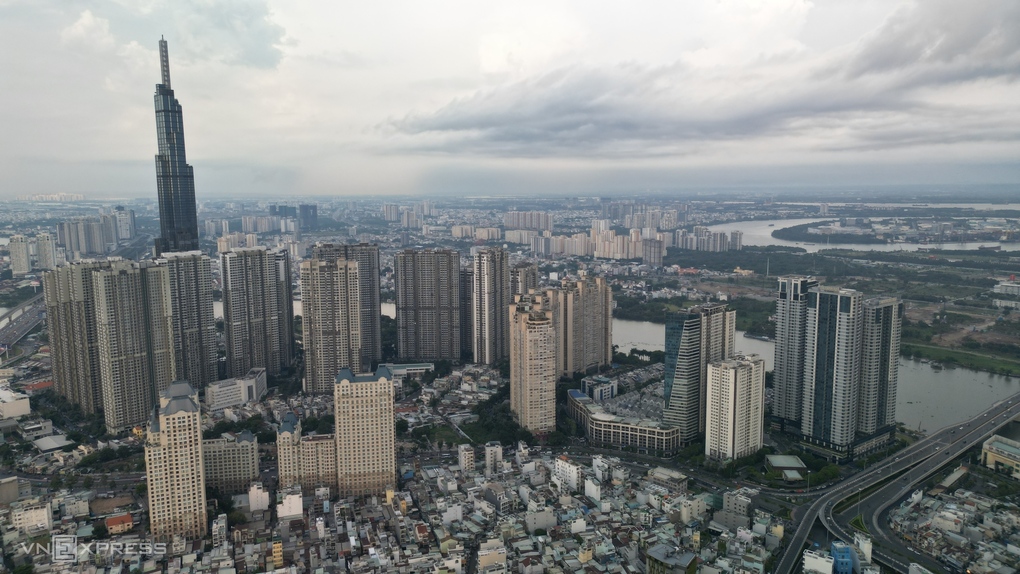
The real estate market in the central area of Ho Chi Minh City. Photo: Quynh Tran
The real estate market in the central area of Ho Chi Minh City. Photo: Quynh Tran
Not only investors, but many genuine homebuyers also fall into financial pressure when cash flow is no longer as expected. Last year, Ms. Nga (40 years old, Ho Chi Minh City) bought a high-end apartment in the Eastern area for nearly 10 billion VND. In addition to 5 billion VND from selling her old house, she borrowed more from the bank and relied on the income from a townhouse being rented out for 50 million VND per month to cover the debt repayment.
However, earlier this year, the old tenant returned the premises, and she had to reduce the rent to 35 million VND per month to find a new tenant. The declining revenue turned her financial plan upside down, while the loan still had to be paid regularly.
After months of struggling, she and her husband decided to list the apartment for sale at hundreds of millions of VND lower than the purchase price to reduce financial pressure. “When seeing housing prices constantly rising, I worried that if I didn’t buy early, I would lose the opportunity. Now I just hope to sell it to lessen the burden,” Ms. Nga said.
Cases like the above are no longer rare in the real estate market after a period of strong price increases lasting the past two years.
According to a report from the Ministry of Construction, apartment prices in Ho Chi Minh City over the past year increased by nearly 26%. Data from Cushman & Wakefield also shows that the increase for the high-end housing segment is 53%. When prices escalate continuously, the common mentality of many buyers is “if I don’t buy now, I will never be able to afford it,” thereby accepting the use of high financial leverage or spending money based on price appreciation expectations.
In addition, many sales campaigns and market information also contribute to reinforcing the FOMO (fear of missing out) mentality, making purchasing decisions more hasty. The consequence is that after hot growth periods, when the market enters a stalling phase, calculations based on expectations begin to face risks.
Real estate expert Le Quoc Kien said this is a fairly common situation among leveraged homebuyers during a hot market period. According to him, a common mistake is betting on the asset’s ability to increase in price instead of calculating financial endurance in adverse scenarios. While housing prices may go sideways or increase slower than expected, bank loans must still be paid on time.
Currently, many real estate loans, after the preferential period, have switched to floating interest rates of 14-15% per year, or even higher. For loans of several billion VND or more, financial costs can increase by tens of millions of VND per month. Meanwhile, declining market liquidity makes selling assets to recover capital increasingly difficult.
“When interest rates rise, income drops, or assets lose liquidity, many people are forced to sell at a loss to reduce financial pressure and avoid the risk of loans turning into bad debts,” Mr. Kien said. According to him, many cases fall into a dilemma: keeping the asset means continuing to bear borrowing costs, while selling means accepting the loss of part of the capital, even losing billions of VND.
Speaking about market liquidity, Ms. Cao Thi Thu Huong, Deputy Director of Savills Ho Chi Minh City, stated that high-value real estate is facing the most obvious liquidity pressure. Genuine homebuyers are finding it increasingly difficult to access commercial housing as prices rise faster than incomes, while investment cash flows tend to be more cautious.
This development causes the secondary market to see more and more cases of price reductions to offload properties. The common adjustment level is from 5% to 10%, mainly concentrated among investors using high financial leverage or facing short-term cash flow pressure.
Ms. Huong added that many real estate businesses no longer have enough room to maintain 2-3 year interest rate support programs as before. The preferential period has now been significantly shortened or only partially applied, shifting the financial burden more onto buyers and continuing to put pressure on demand.
Experts suggest that a safe debt repayment ratio should only account for a maximum of about 30% of monthly income, and the loan value should not exceed 40% of the asset value. However, during the period of strong housing price increases, many people far exceeded these safe thresholds with the expectation that their income would continue to rise or the asset would soon become profitable. When the cash flow endurance capacity is exceeded, homebuyers should prioritize financial preservation rather than continuing to expect profits.
Phuong Uyen





Leave a Reply