
How to arrange your living room for comfortable World Cup viewing
Adjusting the TV position, seating, lighting, and sound in the living room can help us watch the World Cup more comfortably, according to experts.
The 2026 World Cup has reached the quarter-finals, so my family has started spending a lot of time watching football in the living room. Our current setup includes a sofa, a coffee table, and a wall-mounted TV. However, when 5-6 people watch together, the walkway becomes cramped, viewing angles are uneven, and it is easy to trip over furniture. How should I adjust the positions of the sofa, coffee table, lighting, and viewing distance for a convenient football-watching experience?
Reader: Hoang Phong (Hanoi)
Expert advice:
Architect Hoang Chuong advises on several ways to arrange the living room for a more comfortable World Cup viewing experience.
Determine the TV position
The TV should be placed on a wall that receives minimal direct sunlight, not directly opposite a large window, and away from the main traffic path. For small apartments, a wall-mounted TV helps reduce floor furniture and frees up space around the console.
The viewing distance should be based on the screen size rather than just the room area. A suitable distance is typically 1.5 to 2.5 times the screen’s diagonal measurement. For a 55-inch TV, the sofa should be about 2.1 to 3.5 meters away from the screen; for a 65-inch TV, the distance should be around 2.5 to 4 meters. For wall-mounted TVs, the ideal height from the floor to the center of the screen is 1.1 to 1.3 meters. If the living room is narrow, you should prioritize a moderate screen size to avoid eye strain from constantly moving your eyes across a large screen.
Arrange seating in a semi-circle
The seating layout determines the lively atmosphere of the football-viewing room. The main sofa should face the screen directly, while single chairs can be slightly angled on both sides, creating a U-shape or a semi-circle. This arrangement ensures that multiple seats have a full view of the screen without having to tilt their necks to follow the action.
The living room still needs to maintain walkways. The main pathway should have a clearance of about 90 cm so two people can pass each other, while the distance between the sofa and the coffee table should be kept at 45 to 60 cm. For small apartments, homeowners can use low stools or folding chairs that can be easily stored away after the match.
Multi-generational households should avoid placing elderly members in seats where they have to twist their necks or sit too close to the speakers. Young children should be kept away from electrical cords, outlets, glass tables, and sharp table edges.

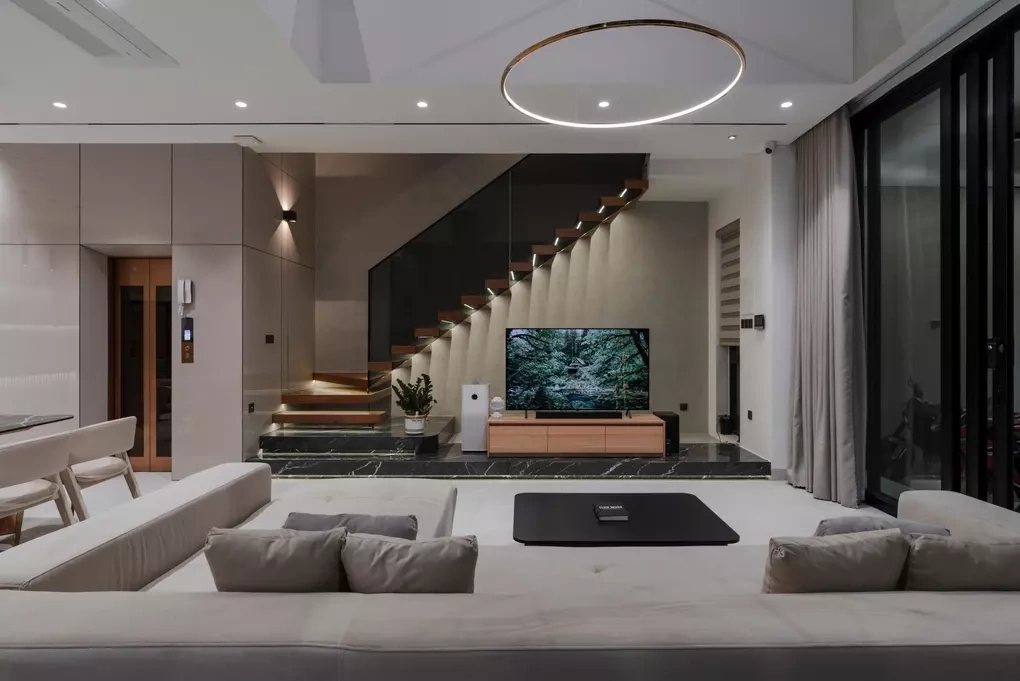
A large sofa, a low coffee table, and a TV placed on the main viewing axis make the living room suitable for World Cup viewing sessions. Photo: SBS
A large sofa, a low coffee table, and a TV placed on the main viewing axis make the living room suitable for World Cup viewing sessions. Photo: SBS
Control the lighting
Unsuitable lighting makes it difficult to watch the game even if there are enough seats. For daytime matches, sunlight glare on the screen can wash out image details. Basic solutions include double-layered curtains, anti-glare roller blinds, or moving the screen to a wall perpendicular to the window. Glass table tops or shiny decorative items should also be moved away from the screen’s reflection zone.
In the evening, the living room should not rely on a single harsh ceiling light. You should create multiple layers of light with different types of lamps and brightness levels. The rule of 5-7 light sources helps the room become less dependent on one central light by combining ambient, task, and accent lighting. For small living rooms, homeowners do not necessarily need to use all 5-7 lights, but there should be at least one indirect light source behind or next to the seating area to reduce contrast between the screen and the room’s background.

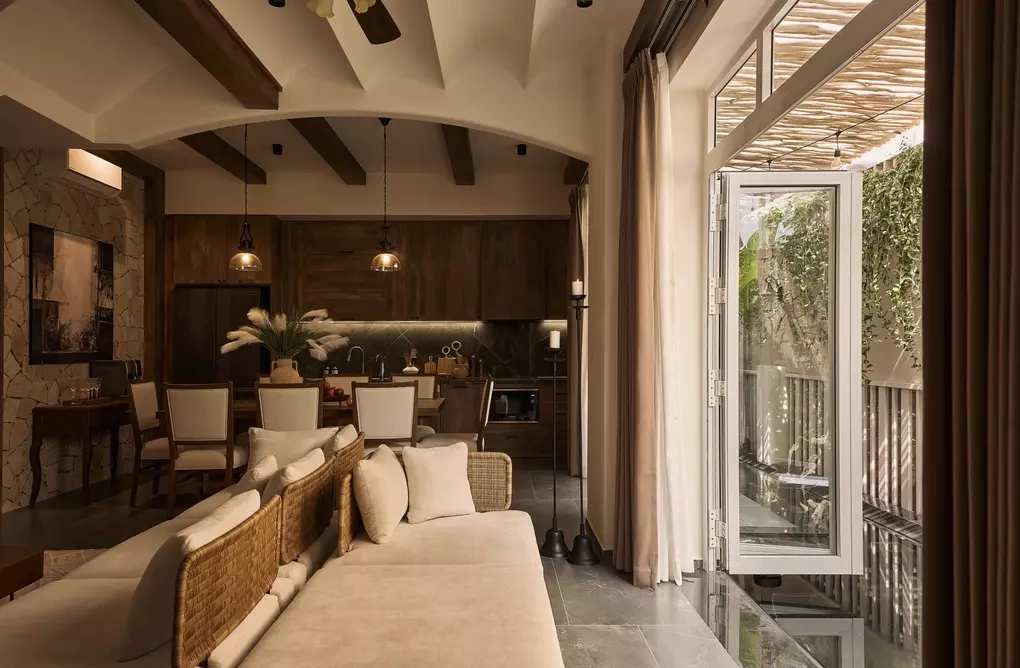
Double-layered curtains combined with uplights and decorative lamps help reduce daytime glare and create a soft background light for evening football matches. Photo: Nguyen Anh Dung
Double-layered curtains combined with uplights and decorative lamps help reduce daytime glare and create a soft background light for evening football matches. Photo: Nguyen Anh Dung
Clear sound, not loud sound
Watching football at home requires clear commentary and stadium atmosphere, but excessively loud speakers can cause floor vibrations, especially in apartments. A soundbar is suitable for many living rooms as it requires fewer wires and can be placed neatly in front of the TV or mounted on the wall below the screen. Soundbars are designed to simulate surround sound with minimal equipment, simple connections, and no need to run multiple speaker wires across the room.
For small living rooms, you should direct the speakers toward the main seating area. Before the match, check the volume at both the furthest and closest seats, then set a suitable level to avoid constantly adjusting it during goals. Power cords, HDMI cables, network cables, and extension cords should be kept close to the wall or run through cable organizers.
Separate the food area from the equipment area
The coffee table often becomes a place for remotes, phones, food, drinks, and charging cables all at once. This habit easily clutters the viewing area and increases the risk of spilling liquids onto electronic devices. A side table, a small rolling cart, or a console table against the wall can help you serve yourself without blocking the screen.
Architect Hoang Chuong, 25 DESIGN








Leave a Reply