
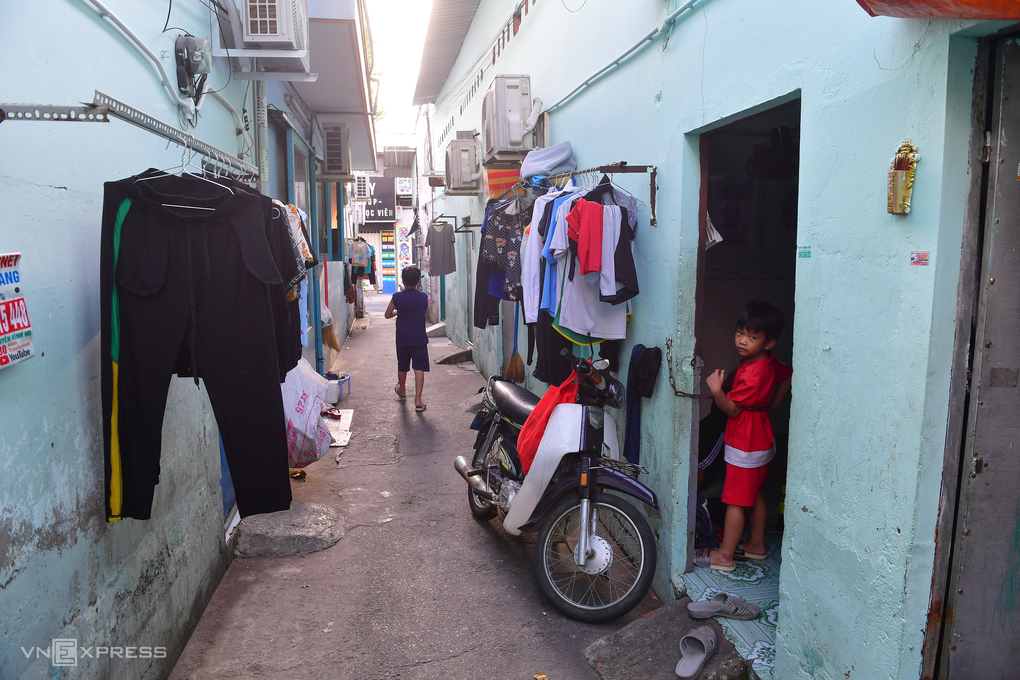
Ho Chi Minh City currently has more than 1.6 million tenants living in private boarding houses, while the supply of social housing for rent and worker accommodation remains modest.
Data from the Ho Chi Minh City Department of Construction shows that the city currently has 72,581 rental housing properties (including both state-owned and private). Among these, independent boarding houses and individual homes combined with rooms for rent account for nearly 60,000 properties, providing nearly 630,000 rooms and meeting the housing needs of over 1.61 million tenants.
The remaining rental housing supply developed by the State and enterprises is still modest. Currently, the entire city has only over 10,000 social housing units for rent, about 2,100 worker accommodation rooms, and 438 official public residences.
The huge gap between official supply and actual demand forces the private boarding house system to continue playing a key role in meeting the housing needs of workers, especially migrant workers and low-income groups.

A worker boarding house area in Ho Chi Minh City. Photo: Thanh Tung
A worker boarding house area in Ho Chi Minh City. Photo: Thanh Tung
Previously, according to the Vietnam General Confederation of Labor, the country currently has about 4.5 to 5 million workers employed in industrial zones, and the majority have to rent housing. However, the rental housing supply for this group is still mainly invested in by households and individuals, with uneven quality and living conditions. Living conditions in many worker boarding houses remain limited, featuring small areas, high occupancy density, a lack of community living space, and degraded infrastructure.
For many years, the housing market has developed with a priority on homes for sale, while the rental segment has not received commensurate investment. As housing prices continue to rise, the demand for long-term rentals grows, but the lack of professional projects leaves private boarding houses as almost the only option for the majority of workers.
Regarding rental housing demand up to 2030, the Department of Construction stated that for workers and laborers in industrial zones alone, the demand for rental housing has reached over 727,000 units. Meanwhile, the city’s registered target to develop worker accommodation during this period is only about 10,000 units, meeting less than 2% of actual demand.
For other groups (civil servants, public employees, armed forces, pupils, students, etc.), the city has not yet completed sociological surveys to fully assess their needs.
The Department of Construction noted that the large gap between rental housing supply and demand is due to the lack of a legal framework to develop rental housing, which fails to attract investors. Current regulations mainly adjust social housing for rent and commercial housing for rent, but there are no policies strong enough to form large-scale rental housing funds.
To promote the development of rental housing, the Ho Chi Minh City Department of Construction believes it is necessary to complete the legal framework soon and add policies attractive enough for businesses to invest.
The city proposes to treat rental housing and social housing projects as urgent project groups to shorten investment procedures; at the same time, it suggests exempting or reducing land use fees, land rent, value-added tax, and corporate income tax for rental housing projects.
The locality also proposes creating a separate preferential credit package with an interest rate of about 3-4% per year, a loan term of 15-20 years, and a three-year grace period for social rental housing projects, worker accommodation, and rental housing. In addition, Ho Chi Minh City recommends that the State support 70-80% of commercial loan interest rates during the initial phase of project investment and operation.
Furthermore, it is necessary to allow commercial housing projects that allocate 50% or more of their housing fund for rent to enjoy preferential mechanisms similar to social housing projects. According to the city, this policy will create incentives for enterprises to develop long-term rental housing, contributing to diversifying the supply instead of focusing only on the sale segment.
From a policy perspective, the Ho Chi Minh City Real Estate Association (HoREA) also believes that in addition to the business sector, the city needs to add support mechanisms for private boarding house owners. According to the association, although the Housing Law has recognized boarding houses as a type of social housing for rent, this group has not yet enjoyed corresponding preferential policies to invest in upgrading facilities, improving safety conditions, and housing quality.
HoREA also recommends that the State implement preferential policies on land, credit, and taxes for rental housing projects priced within the financial reach of workers; prioritize planning this model near industrial zones, export processing zones, and public transport routes to reduce living costs, improve quality of life, and ensure social security for millions of migrant workers.
Phuong Uyen




Leave a Reply