
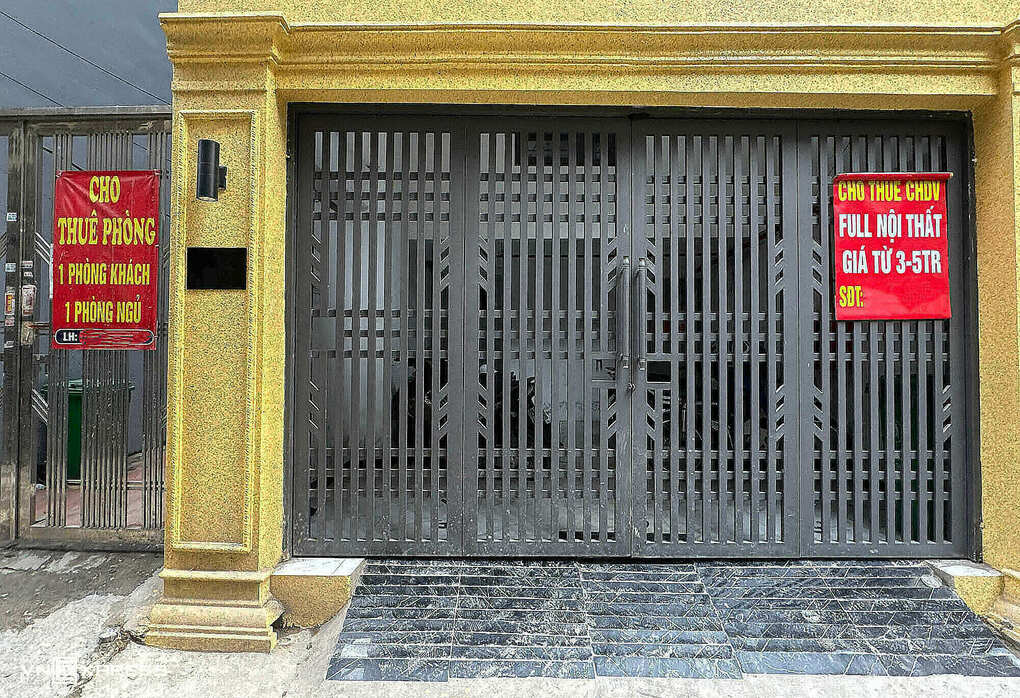
Many areas known as mini-apartment hubs in Hanoi are struggling to fill their vacancies due to high supply and high rental prices.
Investing in a mini-apartment building in Dinh Thon, Tu Liem ward, Hung (40 years old) said that for the past three months, his building has constantly had 20-25% of its rooms vacant. He mentioned that the building has 20 rooms handed over late last year, all fully furnished with beds, refrigerators, wardrobes, washing machines, air conditioners, and more. The rental price ranges from 4.2 to 6.5 million VND for units measuring 20-28 square meters.
At the same time, there are 3 to 4 new mini-apartment buildings handed over for rent around his property. Despite facing fiercer competition, he finds it hard to lower the rent because of rising loan interest rates.
About 800 meters from Hung’s alley, a mini-apartment building managed by Huyen (32 years old) in an alley on My Dinh Street has also been displaying for rent signs for months. She said the building was completed nearly a year ago, but it has only been fully occupied for half of that time. Since the beginning of the second quarter, the vacancy rate has increased by another 15%. Not only in the My Dinh area, a 6-story mini-apartment building in Duong Quang Ham, Cau Giay, which she also manages, has shared the same fate of hanging signs for months to find tenants.
A series of newly built mini-apartment buildings have emerged, creating an abundant supply, while tenants are tightening their belts and landlords are refusing to lower prices, leading to an increase in vacancy rates, she said.
Recently, many areas considered mini-apartment hubs such as My Dinh, Phu Do, Ho Tung Mau, Pham Van Dong, Tran Thai Tong, Duong Quang Ham, and Khuong Dinh have also seen for rent signs popping up. Nguyen Tuan Anh, manager of a real estate brokerage firm specializing in rentals in Hanoi, said that in the My Dinh area alone, nearly a dozen newly handed-over rental buildings have been listed with his firm to find tenants, but after months of advertising, they still have not reached 100% occupancy. He noted that although the buildings are brand new, it is difficult to find tenants because it is the low season, prices remain high, and tenants have to share rooms to afford them.

A building displaying for rent signs in My Dinh, Tu Liem ward, Hanoi. Photo: Ngoc Diem
A building displaying for rent signs in My Dinh, Tu Liem ward, Hanoi. Photo: Ngoc Diem
In reality, the large supply and high rents are barriers that make many tenants think twice when choosing new mini-apartments. Duc Thinh, an office worker at a tech company in Duy Tan, Cau Giay, said he has spent nearly two weeks looking for a room near his workplace without success. In surrounding areas like Dich Vong Hau and Tran Thai Tong, there are many new mini-apartment buildings, but Thinh noted that prices are usually 4.5 to 8 million VND per month for an area of 20-30 square meters. Options under 4 million VND are mostly small units in old buildings, located deep in alleys, with cramped and stuffy spaces.
Currently, Thinh and three friends are renting a 55-square-meter apartment in Tay Mo for 9 million VND. Including electricity, water, and service fees, the monthly cost is about 3 million VND per person. I planned to move closer to my company for a more convenient commute, but finding a room is too difficult because prices are so high, he said.
Data from the online real estate listing platform Batdongsan shows that by June, the number of mini-apartment rental listings on this platform increased by more than 3% month-on-month. Despite a drop in interest and high vacancy rates, rental prices still increased by 3.4% compared to the same period last year.
This trend is also partly reflected in statistical agency data. In the second quarter, the consumer price index increased by nearly 5.3% year-on-year. Among this, the rental housing price index rose by 6%, contributing to a 0.85% increase in the CPI.

A mini-apartment building displaying a for rent sign on Tran Quốc Vuong, Cau Giay, Hanoi. Photo: Ngoc Diem
A mini-apartment building displaying a for rent sign on Tran Quốc Vuong, Cau Giay, Hanoi. Photo: Ngoc Diem
Commenting on these developments, Pham Duc Toan, CEO of EZ Property, said that in the previous period, profits from the mini-apartment and serviced apartment investment model were highly attractive. Many individual investors rushed to pour capital into buying land in narrow alleys and building rental houses to generate cash flow. Up to now, a series of new buildings have been put into operation, pushing supply up sharply. Meanwhile, tenants are facing many pressures from economic fluctuations and rising inflation, leading them to tighten spending, and demand is not yet enough to absorb the volume of new rooms.
Toan noted that high vacancy rates are concentrated in newly built, expensive rental properties located deep in alleys, which are heavily furnished but not optimized for functionality. Meanwhile, tenants now have many alternatives, such as commercial apartments and serviced apartments with synchronous amenities and guaranteed security.
Sharing this view, Vo Hong Thang, Deputy General Director of DKRA Consulting, said that after years of continuous increases, rents in many central areas have reached a high threshold. In a context where the incomes of many young workers have not increased proportionally, they tend to choose roommates or move to areas far from the center to save costs. For example, with a rent of 6-9 million VND for a mini-apartment, tenants will consider moving to a commercial apartment project, accepting a longer commute to enjoy more amenities and better security.
He said the difficulty in filling boarding rooms and mini-apartments shows that the market has entered a stage of competition in operational quality, instead of just finishing construction and immediately filling rooms like a few years ago. Properties with good locations, professional management, and reasonable rents still hold a major advantage, while mid-quality buildings will have to accept lowering rents or adding more service incentives to retain customers.
To improve the quality of the rental housing supply, the Ministry of Construction recently proposed that localities provide support mechanisms, technical standards guidance, and fire safety regulations. Incentives apply to households and individuals participating in the construction of multi-story, multi-apartment individual houses for rent (also known as mini-apartments). Localities also need to inspect environmental sanitation, security, and order for this type of housing.





Leave a Reply