
Foreign giants increase investment in Hanoi shopping malls
Alongside Lotte and Aeon, the capital’s retail market is becoming increasingly competitive with the expansion wave of several foreign enterprises such as Keppel and Takashimaya.
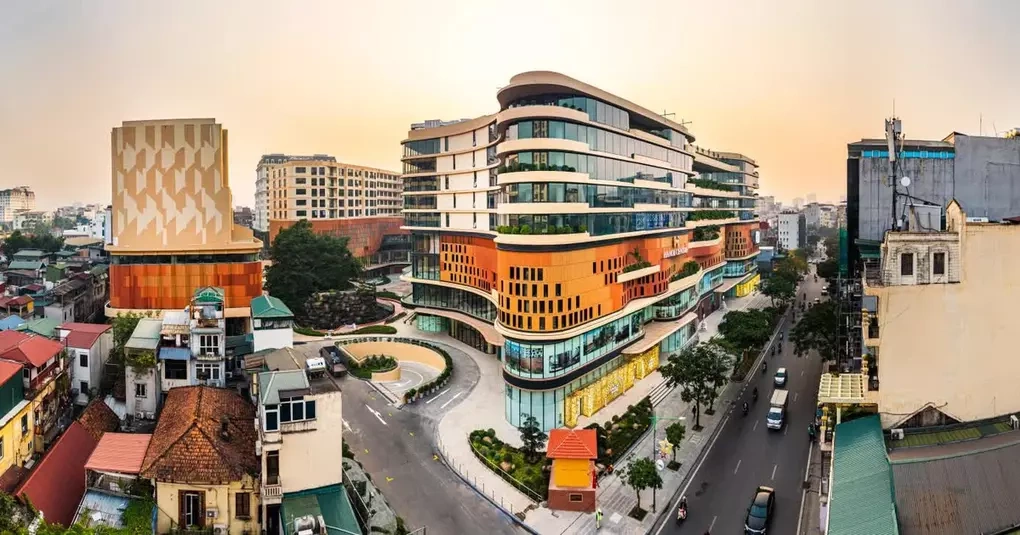
In early July, Singapore-based Keppel Group launched the Hanoi Centre shopping mall at 175 Nguyen Thai Hoc Street. This is the first shopping mall managed and operated by the unit in Hanoi, located within the Tien Bo Plaza complex with a floor area of over 41,000 square meters. A representative from Keppel said that the occupancy rate of the project has reached over 90% so far.
Japanese retail brand Takashimaya is also planning to expand in Hanoi, following the success of the Saigon Centre project in Ho Chi Minh City. The location targeted by Takashimaya to open a shopping mall is the Westlake Square Hanoi tower in the West Lake West area. A representative from Toshin Development, the project developer, said the shopping mall is expected to start operations in the third quarter of 2027.
Previously, many foreign developers such as Lotte, Aeon, or Central Retail had increased their presence in the capital. Real estate services firm Avison Young stated that many projects have tenant occupancy rates exceeding 95%, such as Lotte Mall West Lake, Aeon Mall Ha Dong, Aeon Mall Long Bien…
According to many market research firms, the investment wave from foreign developers has added a large supply of retail space to the capital after years of scarce new projects. CBRE Vietnam reported that in the first half of the year, the market welcomed nearly 51,000 square meters of new supply, mainly from Hanoi Centre and ROX Tower Goldmark City. The absorption rate reached over 48,000 square meters, indicating positive demand for new projects. In the central area, the vacancy rate remained low at 2%, while the non-central area decreased slightly to nearly 10%.
Similarly, Avison Young assesses that the Hanoi retail market tends to gradually expand to new urban areas in the west and north. In addition to increasing their presence, major retail corporations are also actively cooperating to diversify retail models and improve the quality of the commercial ecosystem. For instance, Vincom Retail and Central Retail Vietnam recently signed a strategic partnership, paving the way for GO! supermarkets to appear in the Vincom system. Avison Young recorded that the average occupancy rate of retail space in the central area reached 87%, while the non-central area was around 78%.

Hanoi Centre shopping mall adds more than 41,000 square meters of floor space to the capital’s market. Photo: Keppel
Hanoi Centre shopping mall adds more than 41,000 square meters of floor space to the capital’s market. Photo: Keppel
Many experts believe that the wave of investment expansion by foreign investors in Hanoi is not a random trend. Ms. Nguyen Hoai An, Senior Director of CBRE Hanoi, said that for many years, the supply of high-quality retail space in the city has grown rather slowly compared to the rate of urban development. Meanwhile, Hanoi is oriented towards developing a multi-center model with an increasing number of large-scale mixed-use projects, leading to rising demand for shopping, entertainment, and experiential activities.
According to the Statistics Office, in the first half of the year, the total retail sales of consumer goods and services reached nearly 3.9 million billion VND, up nearly 13% over the same period. This growth reflects the strong recovery of the service and trade sectors amid the continued growth of the middle class.
Looking at the success stories of many international retail giants, Ms. Hoang Nguyet Minh, General Director of Cushman & Wakefield, said their advantage lies in thorough investment starting from market research to layout design, avoiding becoming outdated after a few years of operation. They have a strategic tenant mix and layout plan, helping to optimize foot traffic and shopping experience with sophisticated and consistent customer service. This is an advantage in winning over young consumers, who are the main demographic visiting modern shopping malls.

Lotte Mall West Lake Hanoi shopping and entertainment center. Photo: Lotte Mall West Lake Hanoi
Lotte Mall West Lake Hanoi shopping and entertainment center. Photo: Lotte Mall West Lake Hanoi
The aggressive expansion of investment by many retail corporations in Hanoi has also intensified competition in this segment. According to Ms. Minh, the continuous increase in supply puts pressure on occupancy rates of both new and existing projects, especially in suburban areas. Additionally, the growing consumer shift toward e-commerce poses a challenge for retailers in retaining customers.
CBRE experts also pointed out that the volatile macroeconomic context (fuel prices, inflation, etc.) could directly affect the purchasing power and operating costs of retailers. The market has also recorded a strong shift from merely leasing space to developing multi-experiential destinations (integrating space, entertainment, and play services) to increase customer interaction.
Ms. Nguyen Hoai An recommended that developers need to increase the proportion of the service and entertainment sectors to optimize the tenant mix, bringing customers back more frequently. Meanwhile, management and operation units should focus on services, promotional programs, price support, as well as entertainment activities to stimulate customer demand to visit shopping malls.
Over the next two years, CBRE forecasts that the Hanoi market will welcome more than 150,000 square meters of retail supply, mainly from the western area. Some typical projects including Westlake Square Hanoi and Thiso Mall could provide about 105,000 square meters of floor space. Rental prices for shopping mall spaces are expected to maintain their upward trend, with demand concentrated in the F&B and fashion sectors.

Leave a Reply