
Despite the continuous improvement in housing supply, real estate transactions dropped sharply due to high borrowing costs, making both real buyers and investors hesitant to spend money.
During the first six months, the real estate market recorded a divergence between supply and liquidity. A report by Dat Xanh Services showed that new supply reached 37,300 products, bringing the total primary supply of the entire market to more than 102,400 products, an increase of about 40% compared to the same period last year.
However, the market-wide absorption volume only reached about 26,100 products, down by up to 62% compared to the second half of last year. Of this, the North accounted for about half of the country’s total absorption, the South contributed about 40%, while the remaining regions accounted for only a small proportion.
Not only did the number of transactions decrease, but the absorption rate also went down across the board. According to Dat Xanh Services, the average absorption rate of the entire market in the first half of the year only fluctuated between 20-30%, down about 10 percentage points compared to the same period last year and up to 30 percentage points lower than the last six months of 2025.
In the North, the absorption rate commonly ranged from 20-30%, down about 10 percentage points year-on-year. The South recorded a rate of 25-30%, but this was also the region with the sharpest decline, dropping about 20 percentage points compared to the same period and 35 percentage points compared to the second half of last year. The Central region maintained an absorption rate of 10-15%, while the Mekong Delta only reached about 7-10%.

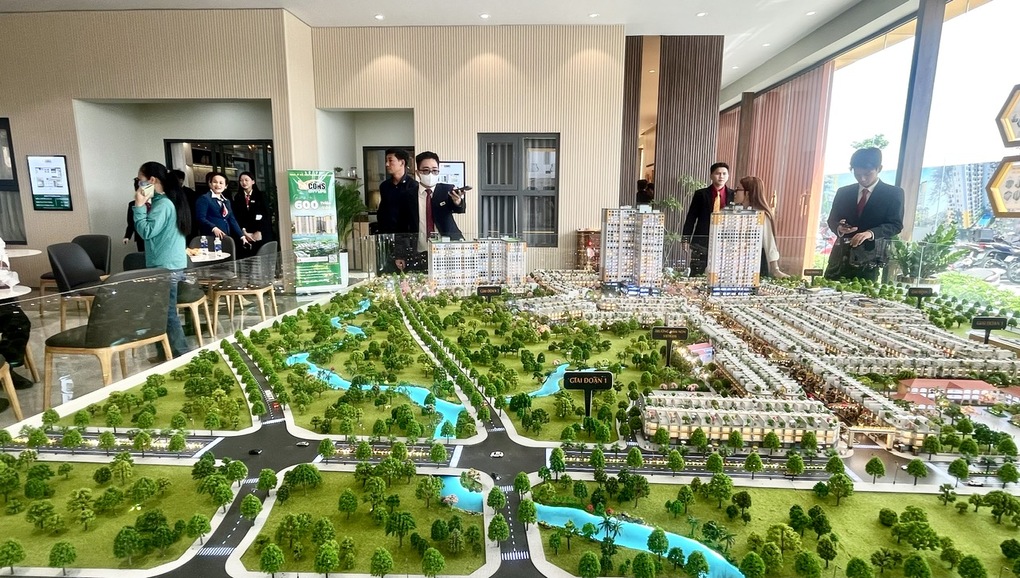
Customers learn about a project in Ho Chi Minh City. Photo: Phuong Uyen
Customers learn about a project in Ho Chi Minh City. Photo: Phuong Uyen
This development was also reflected in Knight Frank Vietnam’s report. In the second quarter, Ho Chi Minh City recorded more than 14,200 apartments offered for sale, while Hanoi had more than 10,300 units. However, the absorption rate in the two markets only reached about 31-48% respectively. Compared to the same period, purchasing power in Ho Chi Minh City decreased by 24%, while Hanoi decreased by 42%.
According to Dat Xanh Services, the main reason for the decline in liquidity is the rising cost of capital. After the promotional period, floating interest rates at many banks have risen to 12-14% per year, putting greater financial pressure on buyers and making them more cautious when spending money.
This assessment was also shared by MB Securities (MBS). The firm stated that by the end of June, credit growth reached 6.77%, while capital mobilization only increased by about 4.7%, putting continued pressure on interest rates. The 12-month deposit rate rose to around 8% per year, pushing medium and long-term lending rates past 12% per year. After the promotional period, home loan interest rates commonly applied by developers are at 12-13%, which is 1-1.5 percentage points higher than in the 2024-2025 period.
According to MBS, the rising cost of capital is becoming a major barrier to real estate purchasing demand. This development shows that the market is entering a rebalancing phase after the strong recovery in 2025. Selling prices are no longer increasing across the board but have shifted to a stable state, reflecting the cautious sentiment of both buyers and sellers in the context of home loan interest rates remaining high.
In this context, according to research firms, both buyers and developers are adjusting their strategies. Buyers tend to delay their purchasing decisions to wait for more stable interest rates and selling prices, while prioritizing projects with complete legal status that meet real housing needs or benefit from infrastructure.
On the business side, developers continue to push project implementation and release products to the market, but sales policies are adjusted more flexibly to stimulate demand instead of offering public price cuts. Brokerage firms also prioritize distributing products with good liquidity, fast cash flow recovery, and high safety levels.
Dat Xanh Services forecasts that the real estate market in the second half of the year is likely to develop cautiously. Under the scenario that this unit assesses as having the highest probability of occurring, supply could increase by an additional 20-30%, while selling prices will mostly move sideways or increase slightly, and the absorption rate will fluctuate between 25-40%.
Cash flow is expected to continue focusing on projects with complete legal status, reputable developers, and those meeting real housing needs. According to research parties, the possibility of a strong market recovery is low in the context of floating interest rates remaining around 13% and volatile economic factors.
Phuong Uyen






Leave a Reply