
The affordable commercial housing segment needs to be standardized based on people’s affordability and subjected to a price ceiling, according to experts.
At a workshop to gather feedback on finalizing the draft Housing Law (amended) organized by the Vietnam Chamber of Commerce and Industry (VCCI) on July 22, many experts argued that the definition of affordable commercial housing needs to be standardized in the law. Currently, the draft defines this as a type of commercial housing that enjoys certain state support policies. Selling and rental prices are determined by developers with a capped profit margin of 10%.
Mr. Nguyen Quoc Hiep, Chairman of GP Invest, proposed a formula to calculate affordable housing prices based on local average income multiplied by a 15-year coefficient of income used to buy a house. The result is then divided by the standard housing area (about 60-70 square meters) to determine an affordable selling price.
For example, in Hanoi, an average monthly income of 16 million VND multiplied by 15 years, divided by the apartment area. For a 70-square-meter unit, the selling price per square meter would be around 40 million VND, while for a 60-square-meter unit, it would be 48 million VND. Mr. Hiep argued that based on this formula, affordable housing prices in the capital should range from 40 to 50 million VND per square meter, especially since social housing unit prices have already exceeded 30 million VND.
Sharing this view, lawyer Vu Khanh Din noted that the draft has correctly identified the vacant segment for middle-income groups who cannot afford regular commercial housing but struggle to qualify for social housing. However, this mechanism only controls inputs and profit margins without ensuring that the output is truly aligned with people’s financial capacity.
He suggested that the affordable commercial housing segment should be measured by affordability, based on household income, standard apartment size, and the maximum housing cost ratio. This housing type needs an annually announced price ceiling and location-based coefficients.

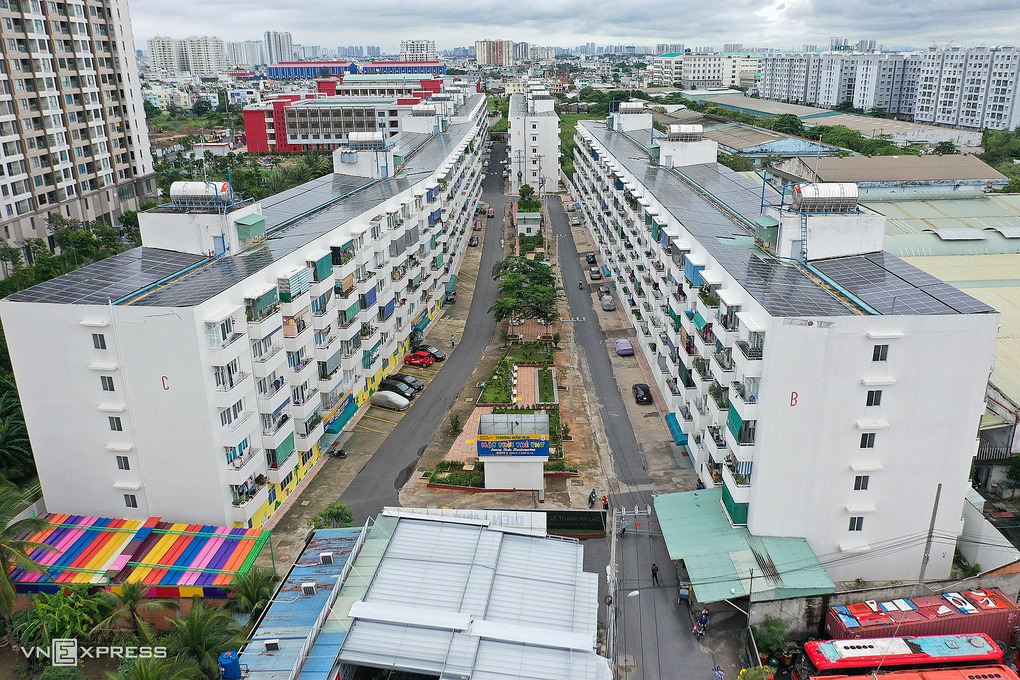
A social housing area in Binh Tan District, Ho Chi Minh City. Photo: Quynh Tran
A social housing area in Binh Tan District, Ho Chi Minh City. Photo: Quynh Tran
From another perspective, Mr. Le Hoang Chau, Chairman of the Ho Chi Minh City Real Estate Association (HoREA), argued that the draft law should not cap the profit margin of developers of affordable commercial housing projects at 10%. Instead, the State should only regulate the selling price ceiling for each locality.
For instance, Ho Chi Minh City could set a price ceiling for this segment at 30 to 70 million VND per square meter, depending on the location. This price range, according to him, would align with the affordability of middle-income earners.
Experts also pointed out that regulations on affordable commercial housing are not yet consistent or synchronized in the draft bill. Real estate legal expert Pham Thanh Tuan stated that the draft restricts the transfer of affordable housing for five years, yet leaves the regulations for social housing to the Government. Applying two different mechanisms to housing types with the same policy objective, according to Mr. Tuan, is unreasonable and reduces administrative flexibility.
The draft also states that besides individuals, organizations are allowed to buy, rent, or lease-purchase affordable housing, but it has not yet provided specific requirements or conditions. Mr. Tuan expressed concern that the supply of affordable commercial housing could be used for investment, business, or asset hoarding, rather than meeting citizens’ actual housing needs.
Restricting individuals in terms of quantity and transfer periods while leaving organizations free of corresponding limitations creates an inconsistency and inequality in policy design, he said.
Therefore, Mr. Tuan suggested that the drafting committee clearly define the purpose and conditions applicable to organizations when buying, renting, or lease-purchasing affordable housing. This should include regulations limiting the number of houses purchased, principles for determining demand, management responsibilities, and transfer conditions. The drafting committee could design this as a separate clause if the policies for organizations and individuals differ.







Leave a Reply