
Instead of copying temperate-zone prototypes, country-style townhouses in Vietnam need to prioritize open spaces, moisture resistance, and optimized finishing materials.
I currently own a 70-square-meter plot of land and want to design a house in the European-American country style. However, I am concerned about its suitability for tropical climate conditions and the specific characteristics of Vietnamese urban townhouses, such as narrow plots, limited facades, high heat, and high humidity.
This style is usually associated with wide, airy spaces and the extensive use of natural materials. Meanwhile, Vietnamese townhouses require additional solutions for shading, ventilation, moisture resistance, and space optimization. I hope to receive expert advice on how to adapt this design style to suit Vietnamese homes.
Additionally, is the finishing cost for a house designed in the European-American country spirit higher than other modern styles? Which alternative materials can maintain the aesthetic while optimizing the budget?
Thank you.
Reader: Hai Anh (Hanoi)
Expert advice:
Homeowners can apply the European-American country style to urban houses in Vietnam, but they should avoid copying templates from temperate regions. The design needs to be adjusted according to the climate, area, and shape of the land plot. The core of this style is to create a warm, relaxing feeling and a connection with nature, rather than cluttered landscape decorations.

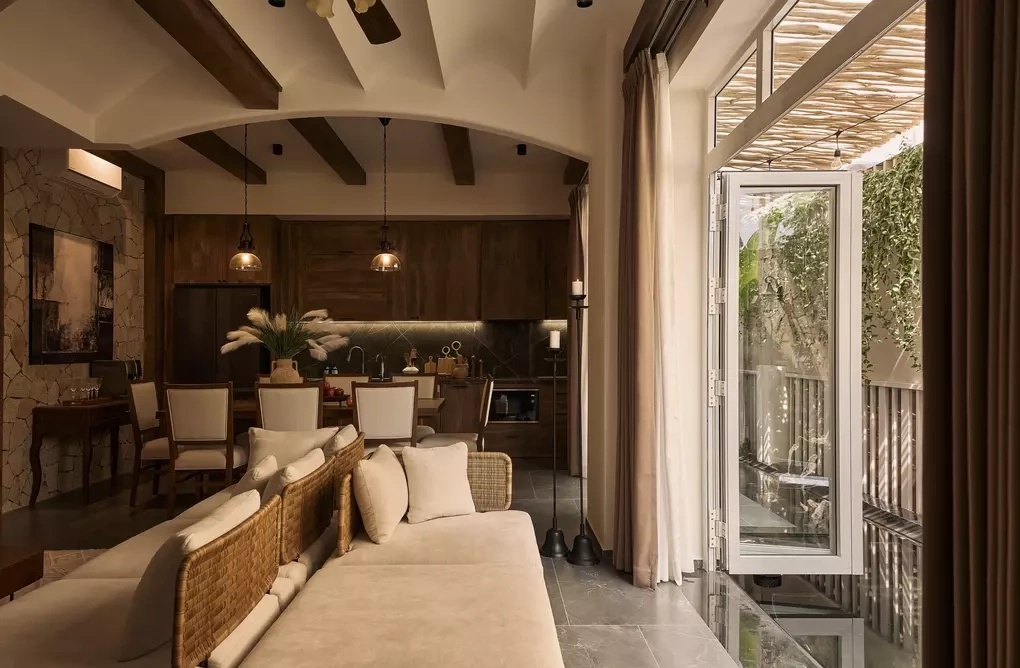
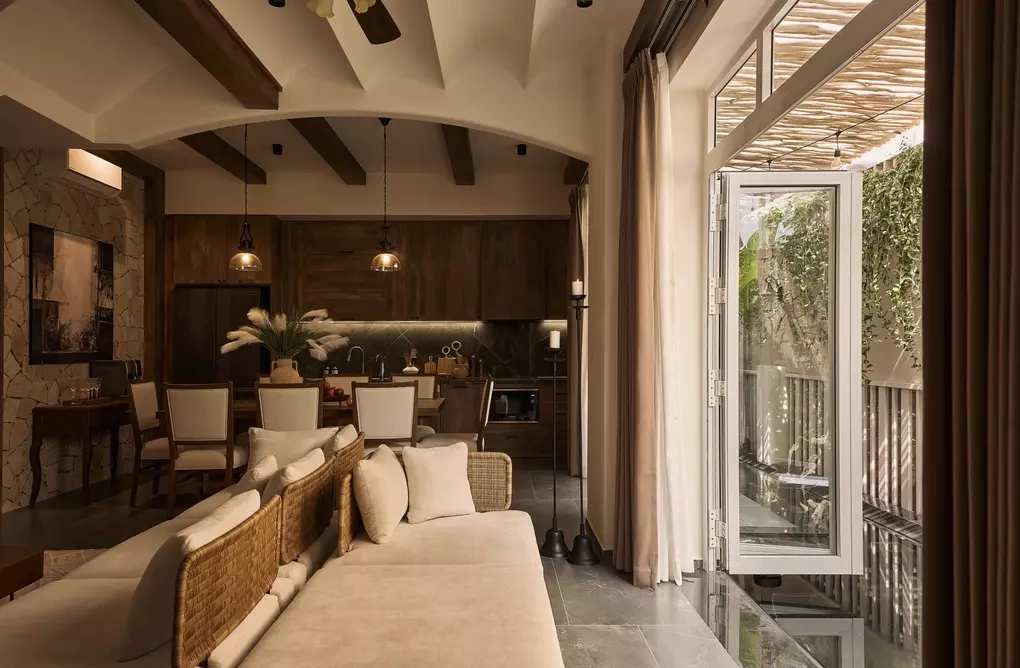
The 183-square-meter villa in Ho Chi Minh City features high glass doors, vaulted ceilings, exposed wooden beams, and stone, wood, and woven rattan surfaces to create a European-American country feel. Photo: 139Design
The 183-square-meter villa in Ho Chi Minh City features high glass doors, vaulted ceilings, exposed wooden beams, and stone, wood, and woven rattan surfaces to create a European-American country feel. Photo: 139Design
Prioritize proportions and transition spaces
The country style needs to be built from spatial proportions before dealing with the interior layers. Ceilings should be high enough, openings appropriately sized, views uninterrupted, and transition layers such as porches, courtyards, gardens, or buffer zones included. These elements help natural light, wind, and greenery become part of the living space, rather than just playing a decorative role.
Characteristic details such as sloped roofs, vaulted ceilings, exposed beams, or thick walls need to be moderated in proportion to the house’s area. When the layout is cramped or the ceiling is low, using too many details can easily make the space feel heavy, reducing the airy and relaxing feel inherent to this style.
For townhouses with narrow widths, homeowners can organize the space vertically or in depth, combining courtyards, skylights, and continuous sightlines. Green spaces should be layered in, rather than concentrated entirely in the front or back yard. A small landscape in the middle of the house can act as a “slice of nature,” bringing light and greenery deep inside.

The country style in the kitchen of a house in Hung Yen is expressed through the olive green kitchen cabinet system and nostalgic details. Photo: Thu Trang
The country style in the kitchen of a house in Hung Yen is expressed through the olive green kitchen cabinet system and nostalgic details. Photo: Thu Trang
Increase climate adaptation solutions
Urban houses in Vietnam need to improve sun shading, cross-ventilation, and reduce heat radiation. The building can apply roof overhangs, sun louvers, wide porches, or buffer zones before the main spaces.
Large window and door openings are still suitable for the country style, but they need to be combined with canopies, curtains, appropriate glazing, and opening directions calculated based on sun and wind. High humidity also affects wood, fabric, paint, and finishing surfaces. Homeowners need to handle waterproofing and moisture prevention from the foundation, walls, and roof to the door areas.
Functionality needs to be organized more compactly than in traditional country houses. Floors should clearly divide common and private spaces while maintaining connections through skylights, courtyards, or large openings. This layout helps the building remain well-ventilated while ensuring privacy.

The three-story villa in Lam Dong arranges the living room and kitchen-dining area on the same floor, combining large glass doors and a skylight to increase light, airiness, and expand the view. Photo: 139Design
The three-story villa in Lam Dong arranges the living room and kitchen-dining area on the same floor, combining large glass doors and a skylight to increase light, airiness, and expand the view. Photo: 139Design
Costs depend on the level of finishing
The country style typically requires an interior finishing budget that is about 10-20% higher than a minimalist modern design with the same area, functionality, and equipment level. The difference can increase to 20-30% if the project uses a lot of wood, natural stone, handmade tiles, and details like ceiling beams, paneled doors, or arches.
Natural materials like wood, stone, and handmade tiles require high costs and meticulous workmanship. However, the project does not need to use entirely authentic materials to capture the country spirit. With this style, homeowners should prioritize real materials in areas that are frequently touched or in the main line of sight, such as handrails, table tops, doors, parts of ceiling beams, and accent stone panels.
On walls or large areas, homeowners can replace them with moisture-resistant industrial wood, veneer, wood-grain laminate, or stone-look porcelain tiles. This solution helps reduce costs, limit warping, and facilitate maintenance in hot and humid climate conditions. When choosing alternative materials, homeowners should also pay attention to the grain ratio, glossiness, and color to avoid a fake or inconsistent feel.
Architect group: Vo Xuan Canh, Tran Minh Khanh, Nguyen Hoang Chuong ( 139Design )


Leave a Reply